Child Awareness DayHaiti child awareness dayHonduras child awareness day Tanzania child awareness day Dominica child awareness daySuriname child awareness dayMalawi child awareness day
Jeconiah Foundation The Fan Fan Foundation

Make Jesus Smile
    home >> imagine me...

Permission requested to use information from www.biosandfilter.org

Complimnent of www.biosandfilter.orgBioSandFilter.org was conceived by Eric Fewster and Adriaan Mol. Together with Sheryl Haw, they own BushProof, a UK registered company that provides socially beneficial products and services specifically tailored for use in developing countries.


Our vision

To significantly contribute towards achieving the Millennium Development Goals through innovative solutions that positively impact the health and wellbeing of people living in low-income countries.

Mission statement
BushProof provides the means to scale up relief and development initiatives for people living in low-income countries. Our innovative technologies and professional services have a rapid and widespread application. BushProof products are specifically designed for the tough and remote environments commonly encountered in much of the developing world. They are easy to use and maintain. They work and last. Durability, affordability and reliability are key features. Delivered rapidly, this guarantees maximum impact where it is needed most.

Training and consultancies provided by BushProof maximise the effectiveness of other organisations to implement cost-efficient, high impact programmes.

BushProof believes that economic and human development is more sustainable when products are commercially viable. This happens when sufficient demand is created for products that are manufactured through the private sector, whilst remaining affordable and available to low-income households. We believe that good market opportunities can be developed for products that improve health and wellbeing.

In order to create local economic benefits, BushProof endeavours to locate production in low-income countries. We are committed to re-investing a percentage of profits into research and pilot programmes in order to broaden the scientific knowledge base of innovative technologies.

BioSandFilter.org therefore presents facts & information;offering the most comprehensive and informative web resource on this technology, including the latest updates on academic research.

We encourage sharing experiences of the filter through a discussion group that provides an environment where practitioners can meet colleagues implementing similar projects in other countries; where field staff have the opportunity to consult experts; where policy makers can meet those wanting to ensure safe drinking water for their own family.

Technical support & quality products: providing easy access to tools and quality bio-sand filter products. If in-depth experience is needed our experienced associates can provide technical support to those needing it, such as NGOs and development organisations.

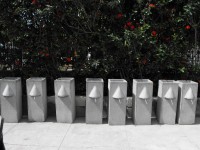
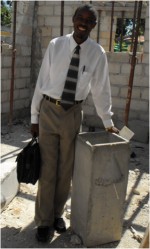
The Concrete Filter

History
Dr. Manz of the University of Calgary made several modifications to the traditional slow-sand filter to allow for intermittent flow and point-of-use water treatment. He discovered that biological layer living in the sand could survive for extended periods of time if the water level is no more than 5 cm above the bio-film. The organisms living in the filter require a constant supply of oxygen. If the resting water level should be higher than 5 cm, oxygen would no longer readily diffuse to the bio-film, which would suffocate. If the water level drops below the recommended level, then there is a risk that inflowing water will disturb the sand and bio-film. The water height is automatically maintained by a raised under drain pipe that connects to the outlet high in the side of the filters, and filling the filter with sand to a level that is 5 cm below the level of the outlet.

Design
The practical outcome of Manz’s research was therefore a concrete box or cylinder with an outlet pipe embedded in its walls. This vessel is carefully filled with suitable sand. A layer of coarse grains on the bottom prevents the finer sand on the top from blocking the outlet, located at the bottom of the unit. The fine sand has a large surface area, which traps dirt more easily. A diffuser plate is located some distance above the sand. Made from a perforated plate, the diffuser protects the sand and the bio-film it contains from scouring effect that would occur when water is poured into the filter. Between the diffuser plate and the top of the sand is the rest level of the water. Much more detailed information on the physical and biological processes involved in bio-sand filtration can be found elsewhere on this website.

Performance
Usually, concrete bio-sand filters can be made cheaply. The main cost is cement. Depending on the type of filter made (round or square), between a quarter and half a bag of cement are needed in addition to some PVC pipe. The filters are robust and long lasting and are usually capable of delivering 60 liters per hour when first used.

Advantages
The concrete filter is widely used in the developing world, having been introduced by NGOs, often through micro-projects. It is possible to establish profitable small-scale enterprises that build and sell filters to their communities. A small business in Kenya, established by Medair, has sold over 2 thousand filters in 4 years, generating a substantial profit. Several links to articles on this successful project are available at the bottom of this page.

Disadvantages
Because a metal mould is needed for the construction of concrete filters, it is not possible to mass-produce them easily. Each mould can only make one filter every two days. Furthermore, the filters can crack during transport or when moved within the house. They are also very heavy and bulky, making them expensive and awkward to transport.

 
Imagine me...Healthy Educated Loved Protected United Caribbean TrustEmerging Global Leaders of BarbadosUNA - UWICircle KIsland ImpactCombined Faith Island Worship
     
Copyright ©  2008 www.UnitedCaribbean.com. All rights reserved. Disclaimer Click to Contact us